
OS by Treatment Duration (Post Hoc Analysis)



You are viewing a post hoc subset analysis of outcomes by treatment duration of the MAIA trial.
This information is not included in the current Prescribing Information and has not been evaluated by the FDA. No conclusions should be drawn. This analysis is not powered to detect a difference in arms and these claims should be understood in the context of the methodology. Subgroups that were compared were not of equal sample sizes and this limits their generalizability. The analyses also did not include an evaluation of overall survival for the Rd control group of the study.
Methodology
In a post hoc subset analysis of patients categorized by treatment duration*
Overall survival based on treatment duration with frontline DARZALEX® + Rd1
To explore the impact of treatment duration on long-term clinical outcomes, a post hoc analysis evaluated DRd treatment response in patients who received DRd for <18 vs ≥18 months.* Patients who discontinued DRd treatment due to disease progression during the first 18 months were excluded.
This analysis included 283 patients out of the 368 ITT population in the ≥18-month DRd arm and 48 patients out of the 368 ITT population in the <18-month DRd arm.
DRd=DARZALEX® (D) + lenalidomide (R) + dexamethasone (d); FDA=U.S. Food and Drug Administration; ITT=intent to treat; OS=overall survival; Rd=lenalidomide (R) + dexamethasone (d).
*At a median follow-up of 56.2 months.
Overall Survival
After a median follow-up of 56.2 months
Overall survival results for patients treated with DRd for <18 months vs ≥18 months1,2*
OS for patients in the DRd arm who received treatment for <18 months vs ≥18 months
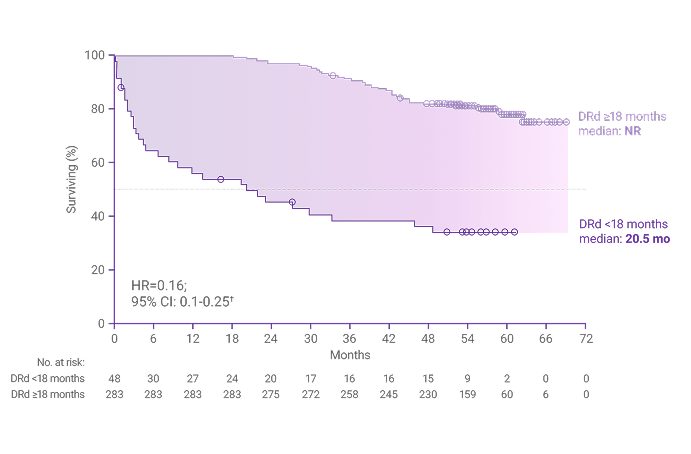
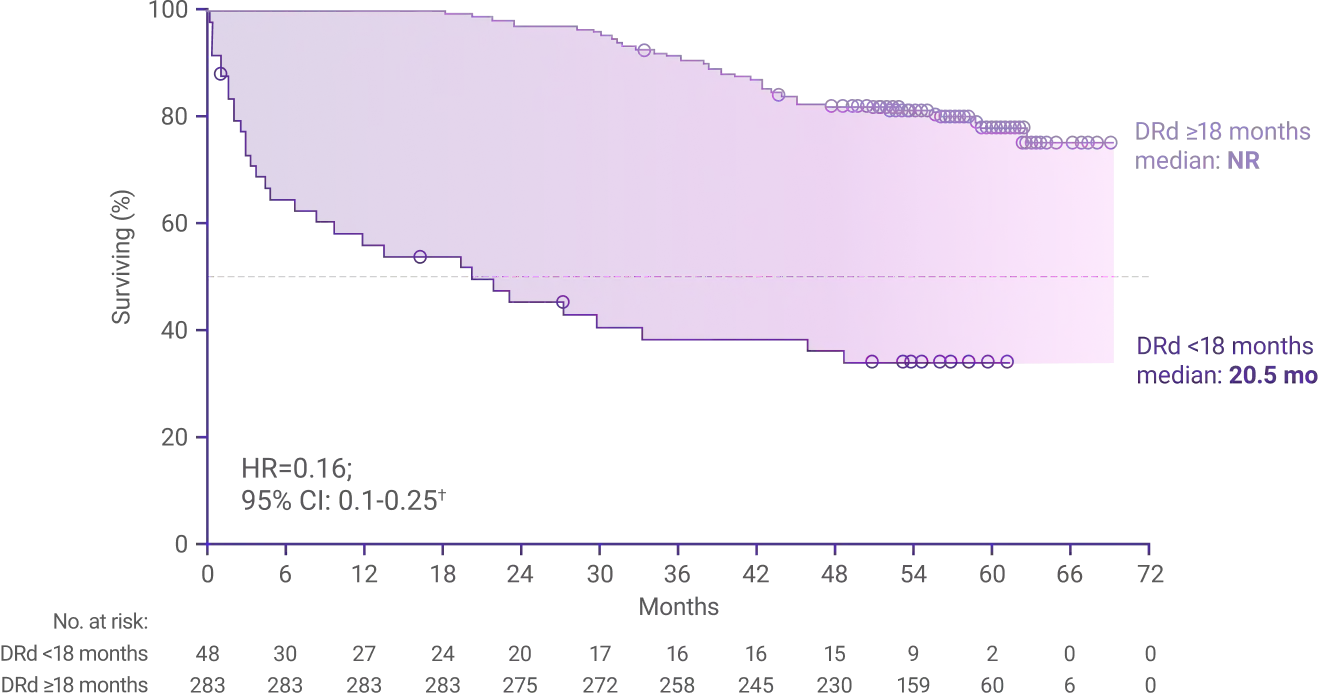
84% risk reduction
for death for those treated with DRd for ≥18 months vs those treated with DRd for <18 months1
CI=confidence interval; DRd=DARZALEX® (D) + lenalidomide (R) + dexamethasone (d); HR=hazard ratio; ISS=International Staging System; NR=not reached; OS=overall survival.
*Patients who discontinued DRd treatment due to disease progression during the first 18 months were excluded.1
†HR and 95% CI were derived from a multivariate Cox proportional hazards model that adjusted for covariates of frailty and ISS disease stage.1



References:
- Moreau P, Facon T, Usmani SZ, et al. Treatment duration and long-term outcomes with daratumumab in transplant-ineligible newly diagnosed multiple myeloma from the phase 3 MAIA study. Poster presented at: 19th International Myeloma Society (IMS) Annual Meeting; August 25-27, 2022; Los Angeles, CA.
- Data on file. PM-01145. Janssen Biotech, Inc.