





High-Risk Subgroup (Post Hoc Analysis)

Heading underline ImageHeading underline Image

Patient Profile: Luis

Examine Luis's case for a deeper understanding of patients for whom frontline DRd may be appropriate.

Meet Luis (Age 76): Patient with high-risk cytogenetics*

Luis, headshotLuis, headshot

*Hypothetical patient case.

Newly diagnosed and not eligible
for transplant

  • Married, father of one, with 2 grandchildren
  • Presents with back and bone pain, and high symptom burden

Clinical condition and disease presentation

ISS disease stage: II

ECOG PS: 2

Cytogenetic risk: Presence of high-risk cytogenetics

Additional considerations

  • Mild anemia (9 g/dL)
  • Shortness of breath

Transplant eligibility of an individual patient is determined based on evaluation by the treating physician.

DRd=DARZALEX® (D) + lenalidomide (R) + dexamethasone (d); ECOG PS=Eastern Cooperative Oncology Group performance status; ISS=International Staging System.

Cytogenetic risk was based on fluorescence in situ hybridization (FISH) or karyotype testing; high-risk cytogenetics were defined as the presence of one or more of the following abnormalities: del(17p), t(4;14), or t(14;16).1

This analysis is not included in the Prescribing Information for DARZALEX®. This analysis was conducted post hoc, and there are insufficient numbers of patients per subgroup to make definitive conclusions of efficacy among the subgroups.

Please see MAIA trial design & primary results

Methodology

After 64.5 months of follow-up:

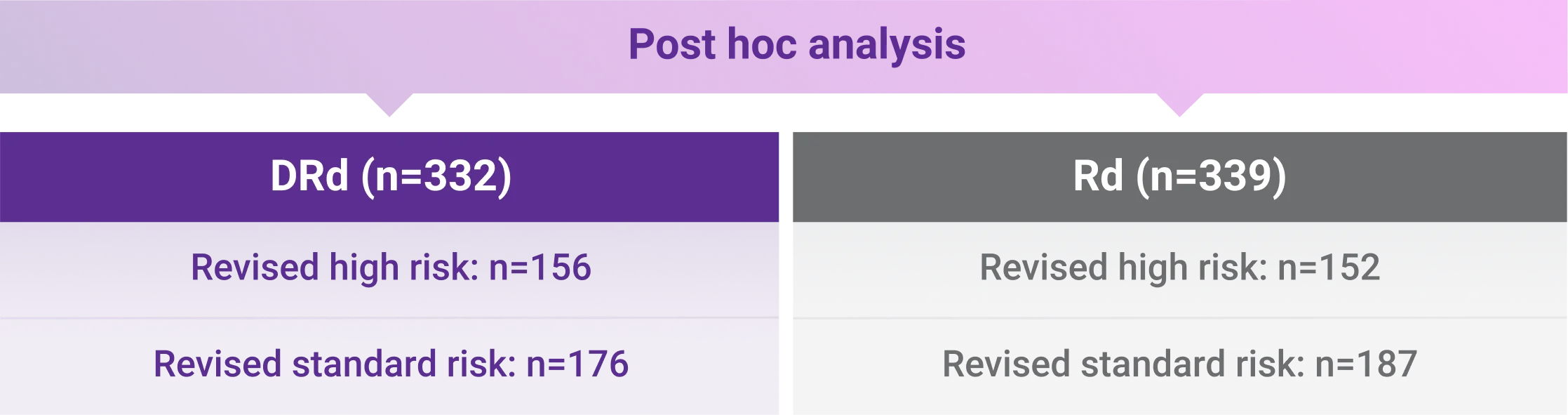
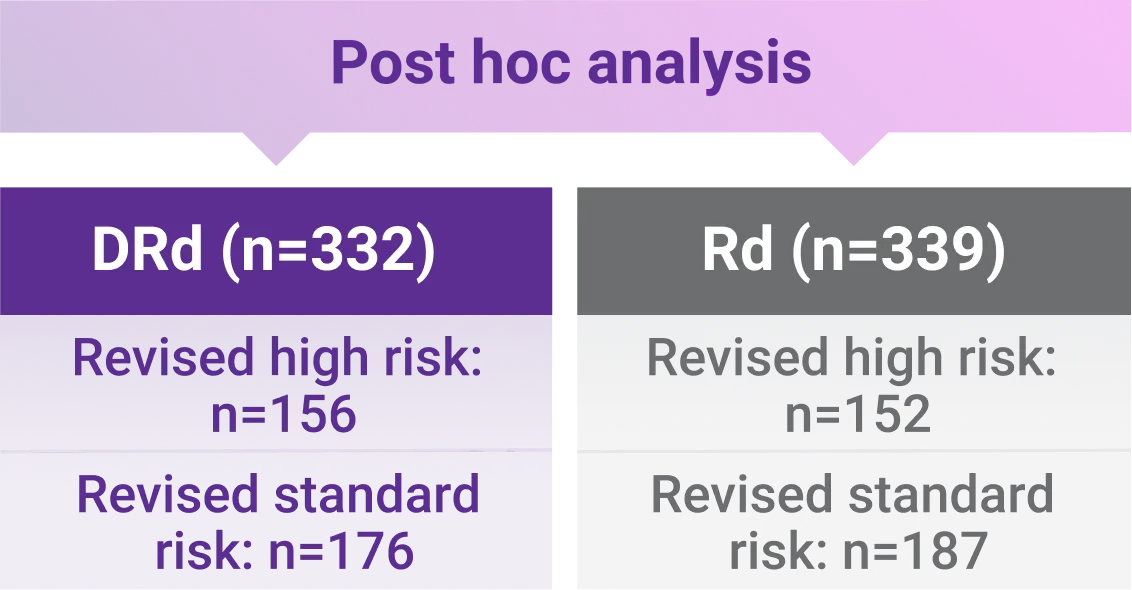
Post hoc analysis of MAIA evaluating long-term outcomes in patients with revised high-risk cytogenetics1*

At the time of MAIA study initiation, the International Myeloma Working Group (IMWG) defined high-risk cytogenetics as presence of at least 1 of the following abnormalities: t[4;14], t[14;16], or del[17p], determined by fluorescence in situ hybridization (FISH) analysis. An updated IMWG consensus statement in 2016 advised on including additional cytogenetic abnormalities, such as t[14;20] and gain[1q21], in clinical trials. These abnormalities, t[14;20] and gain[1q21], are also included in the Mayo Stratification for Myeloma and Risk-Adapted Therapy (mSMART) guidelines for classifying high-risk cytogenetics. Standard-risk cytogenetics was defined as the absence of these cytogenetic abnormalities.2-9

Biomarkers collection per MAIA Clinical Study Protocol: Biomarker samples were evaluated to determine the clinical benefit of DRd in high-risk molecular subtypes. Prespecified biomarkers were t[4;14], t[14;16], del[17p], specific gene signatures, and specific mutations. Samples for biomarker evaluations were collected as specified per the Time and Events Schedule and could be used for additional biomarker testing at a later time. As part of the post hoc analysis presented, a retrospective evaluation of additional biomarkers that represent high-risk cytogenetics, t[14;20], gain[1q21], and amp[1q21], was conducted.10

Cytogenetic abnormalities, t[4;14], t[14;16], del[17p], t[14;20], gain[1q21], or amp[1q21], were detected based on FISH or karyotype analysis.1

amp=amplification; del=deletion; DRd=DARZALEX® (D) + lenalidomide (R) + dexamethasone (d); FISH=fluorescence in situ hybridization; PFS=progression-free survival; Rd=lenalidomide (R) + dexamethasone (d); IMWG=International Myeloma Working Group; t=translocation.

*Median follow-up was 64.5 months.1

Per protocol, cytogenetic tests from bone marrow aspirates were performed by local laboratories at screening, and 642 patients had baseline cytogenetic data reported from local laboratories out of the 737 patients who were enrolled in MAIA. At a later date, additional tests were performed by a central laboratory and assay cutoffs assigned at the central laboratory were used to detect gain[1q21] and amp[1q21], which identified additional high-risk patients. This included patients with no cytogenetic data from local laboratories whose status was revised as high risk, increasing the number of patients with cytogenetic data to 671 patients.1,4

Progression-Free Survival

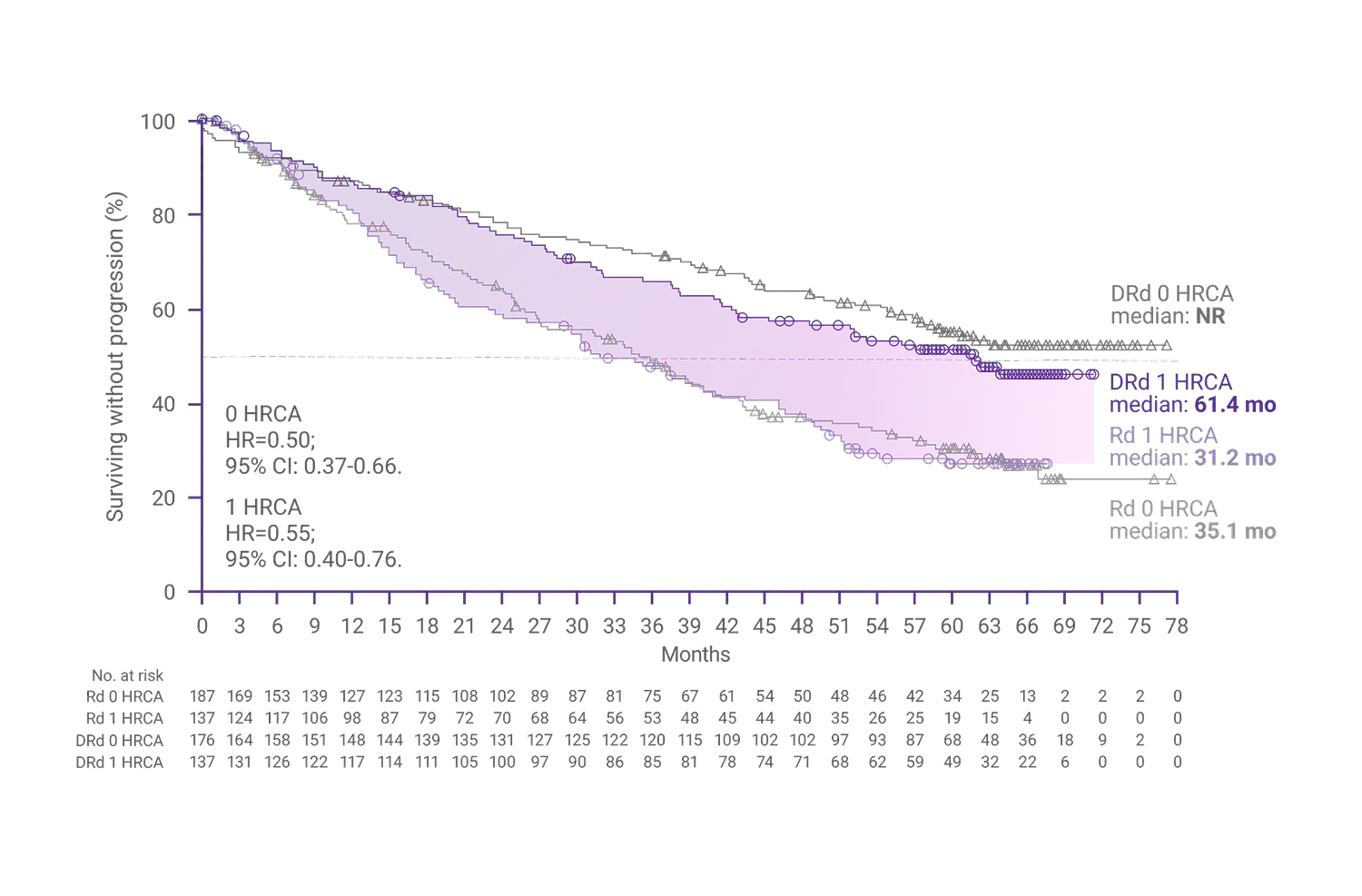
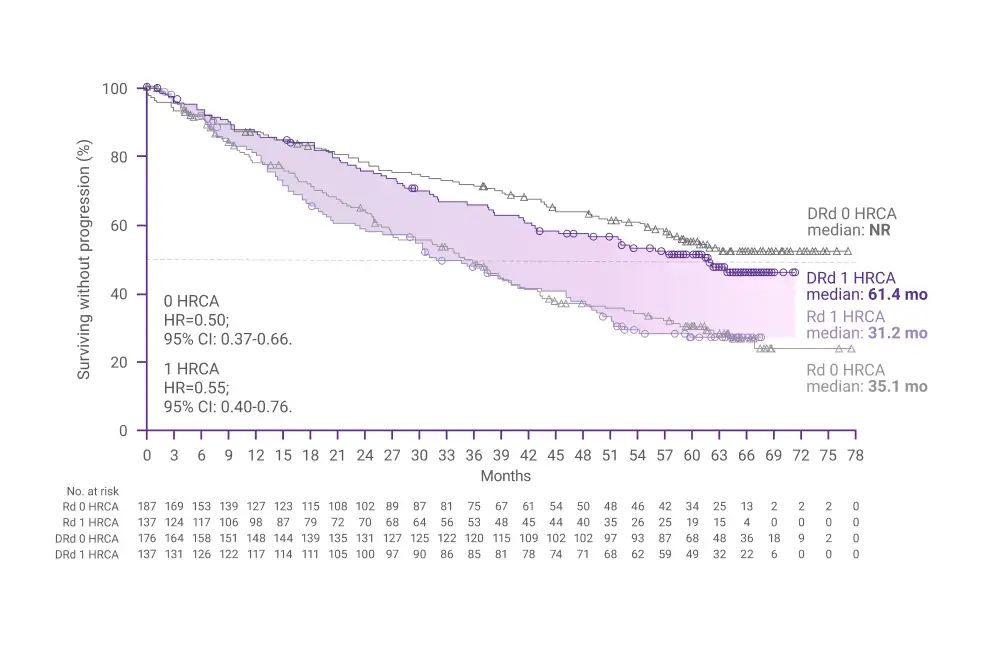
In a post hoc subgroup analysis of patients with revised high-risk cytogenetics:

Median PFS was 61.4 months with DRd vs 31.2 months with Rd alone among patients with 1 high-risk cytogenetic abnormality1*

Progression-free survival (PFS)1

Revised high-risk cytogenetics defined as having at least 1 of the following 6 abnormalities: t[4;14], t[14;16], del[17p], t[14;20], gain[1q21], or amp[1q21].1

  • Among patients with revised standard cytogenetic risk (0 HRCA), median PFS was not reached with DRd vs 35.1 months with Rd alone (HR=0.50; 95% CI: 0.37-0.66)1*

This analysis was conducted post hoc and no conclusions should be drawn.

View ≥2 HRCAs

 amp=amplification; CI=confidence interval; del=deletion; DRd=DARZALEX® (D) + lenalidomide (R) + dexamethasone (d); HR=hazard ratio; HRCA=high-risk cytogenetic abnormality; NR=not reached; PFS=progression-free survival; Rd=lenalidomide (R) + dexamethasone (d); t=translocation.

*Median follow-up was 64.5 months.1

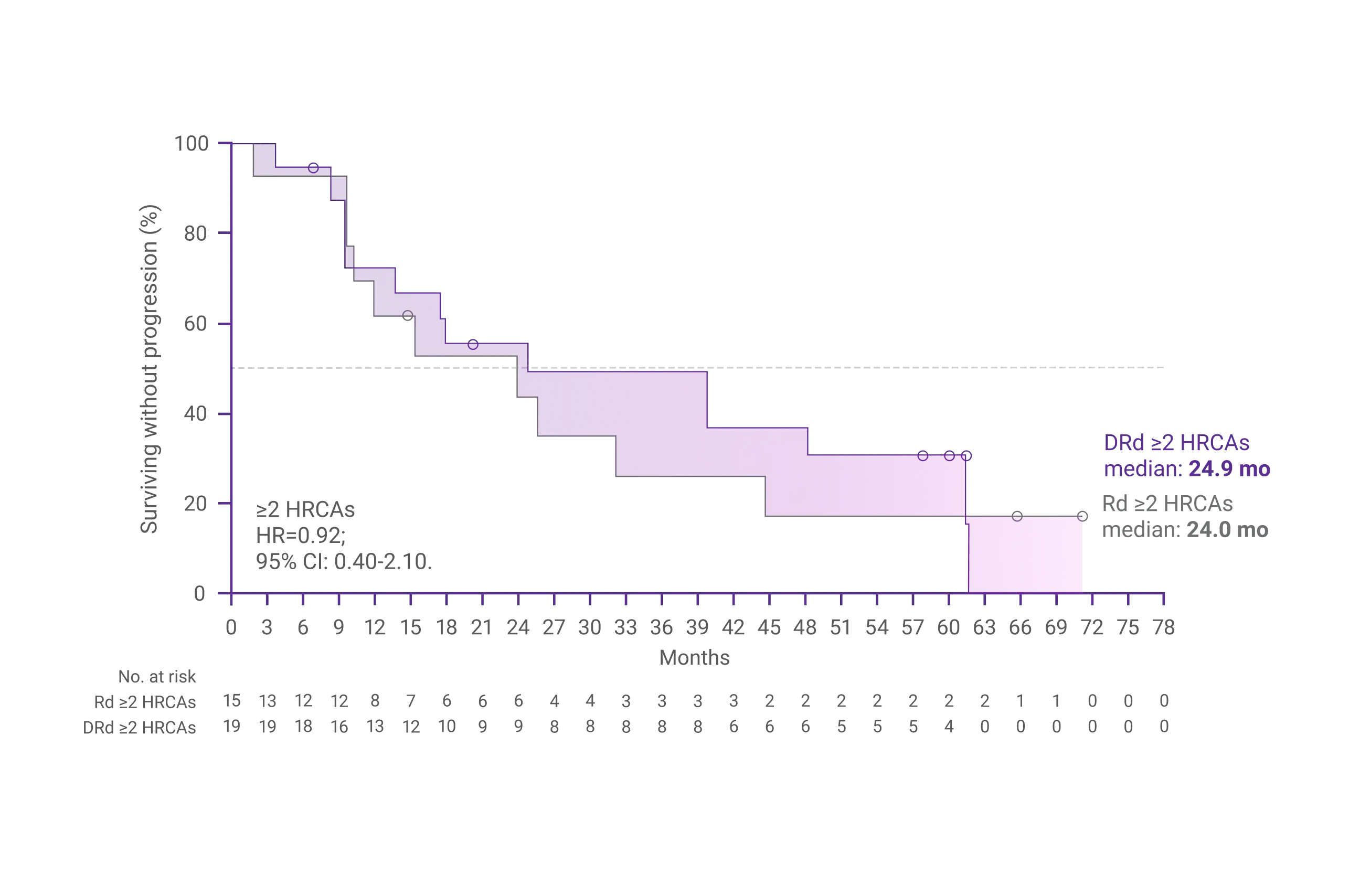
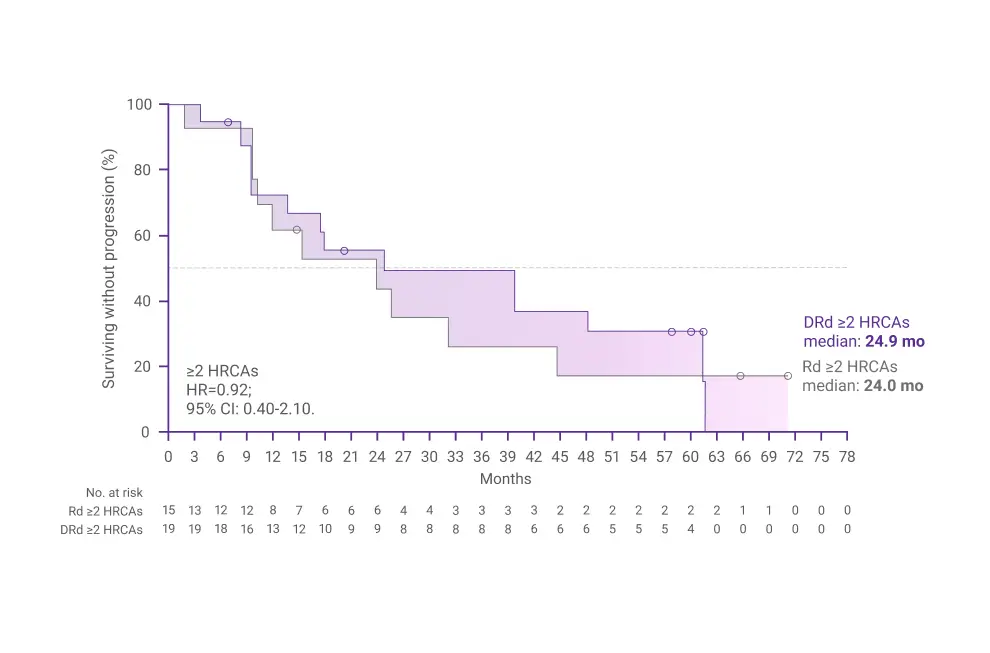
In a subgroup analysis of patients with revised high-risk cytogenetics:

Median PFS was 24.9 months with frontline DRd vs 24.0 months with Rd alone among patients
with ≥2 high-risk cytogenetic abnormalities1*

Progression-free survival (PFS)1

Revised high-risk cytogenetics defined as having at least 1 of the following 6 abnormalities: t[4;14], t[14;16], del[17p], t[14;20], gain[1q21], or amp[1q21].1

This analysis was conducted post hoc and no conclusions should be drawn.

View Isolated Gain(1q21)

 amp=amplification; CI=confidence interval; del=deletion; DRd=DARZALEX® (D) + lenalidomide (R) + dexamethasone (d); HR=hazard ratio; HRCA=high-risk cytogenetic abnormality; PFS=progression-free survival; Rd=lenalidomide (R) + dexamethasone (d); t=translocation.

*Median follow-up was 64.5 months.1

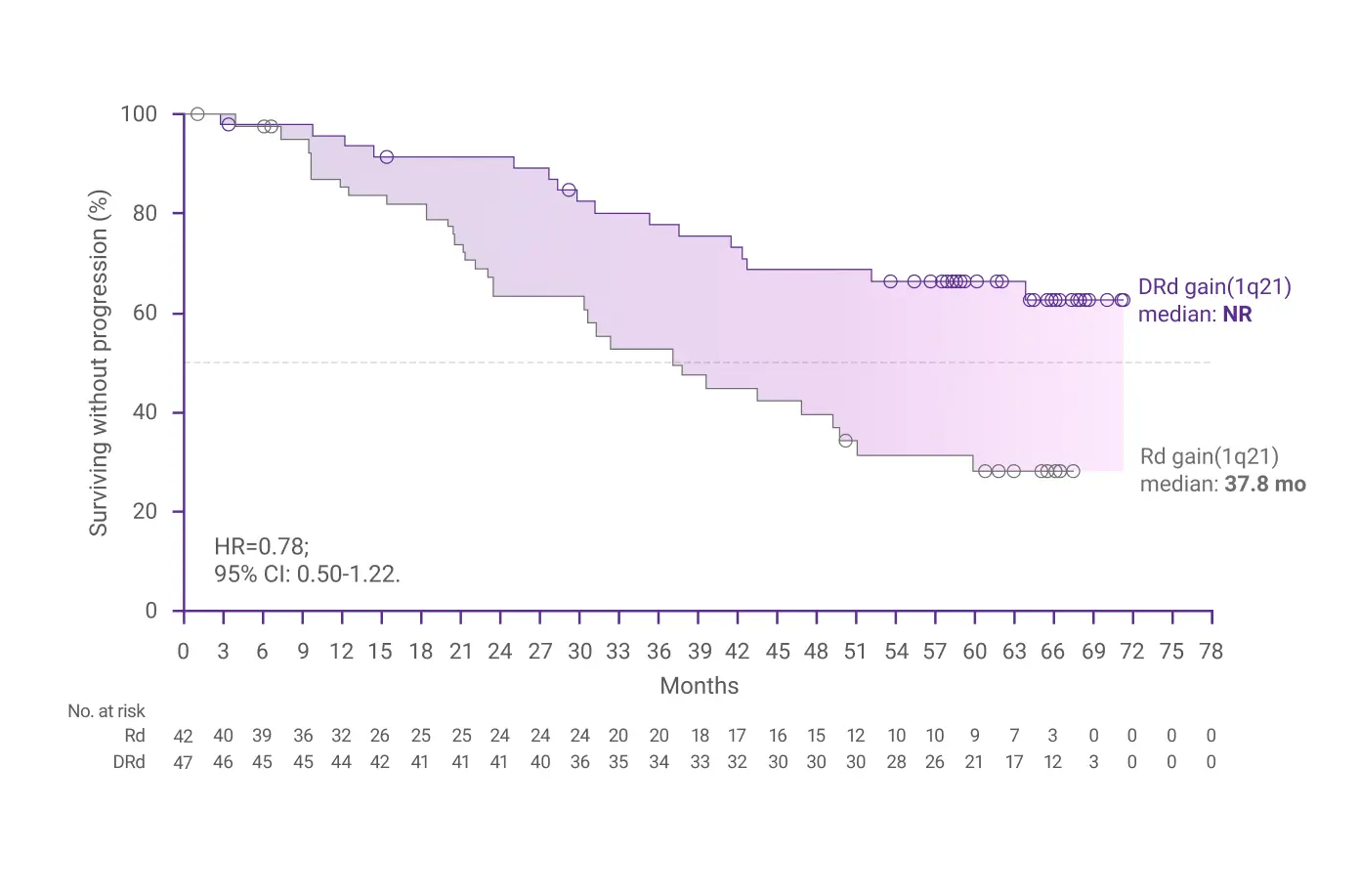
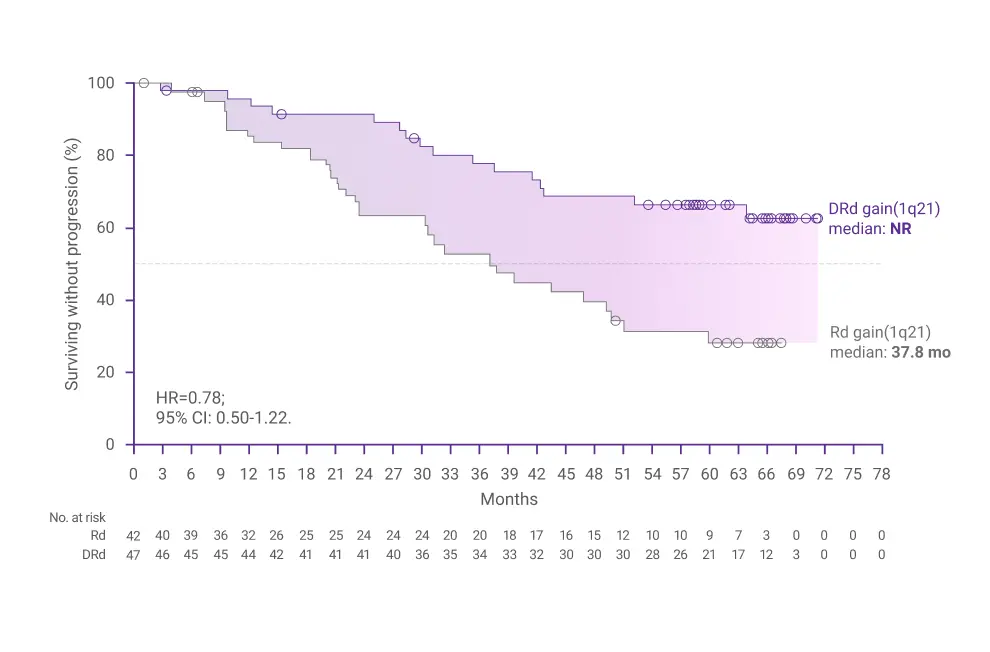
In a post hoc subgroup analysis of patients with revised high-risk cytogenetics:

Median PFS was not reached with DRd vs 37.8 months with Rd alone among patients with an isolated gain(1q21) cytogenetic abnormality1*

Progression-free survival (PFS)1

Revised high-risk cytogenetics defined as having at least 1 of the following 6 abnormalities: t[4;14], t[14;16], del[17p], t[14;20], gain[1q21], or amp[1q21].1

This analysis was conducted post hoc and no conclusions should be drawn.

 amp=amplification; CI=confidence interval; del=deletion; DRd=DARZALEX® (D) + lenalidomide (R) + dexamethasone (d); HR=hazard ratio; HRCA=high-risk cytogenetic abnormality; NR=not reached; PFS=progression-free survival; Rd=lenalidomide (R) + dexamethasone (d); t=translocation.

*Median follow-up was 64.5 months.1

References:

  1. Moreau P, Facon T, Usmani SZ, et al. Daratumumab plus lenalidomide and dexamethasone (D-Rd) versus lenalidomide and dexamethasone (Rd) in transplant-ineligible patients with newly diagnosed multiple myeloma (NDMM): clinical assessment of key subgroups of the phase 3 MAIA study. Poster presented at: 64th American Society of Hematology (ASH) Annual Meeting & Exposition; December 10-13, 2022; New Orleans, LA.
  2. Fonseca R, Bergsagel PL, Drach J, et al. International Myeloma Working Group molecular classification of multiple myeloma: spotlight review. Leukemia. 2009;23(12):2210-2221.
  3. Chng WJ, Dispenzieri A, Chim CS, et al. IMWG consensus on risk stratification in multiple myeloma. Leukemia. 2014;28(2):269-277.
  4. Data on file. PM-00913. Janssen Biotech, Inc.
  5. Durie BGM, Kumar SK, Usmani SZ, et al. Daratumumab-lenalidomide-dexamethasone vs standard-of-care regimens: efficacy in transplant-ineligible untreated myeloma. Am J Hematol. 2020;95(12):1486-1494.
  6. Facon T, Kumar S, Plesner T, et al; the MAIA Trial Investigators. Daratumumab plus lenalidomide and dexamethasone for untreated myeloma. N Engl J Med. 2019;380(22):2104-2115.
  7. Sonneveld P, Avet-Loiseau H, Lonial S, et al. Treatment of multiple myeloma with high-risk cytogenetics: a consensus of the International Myeloma Working Group. Blood. 2016;127(24):2955-2962.
  8. Mayo Clinic. mSMART: Mayo Stratification for Myeloma And Risk-adapted Therapy. Newly diagnosed myeloma. Reviewed February 2023.
  9. Mikhael JR, Dingli D, Roy V, et al. Management of newly diagnosed symptomatic multiple myeloma: updated Mayo Stratification of Myeloma and Risk-Adapted Therapy (mSMART) consensus guidelines 2013. Mayo Clin Proc. 2013;88(4):360-376.
  10. Facon T, Kumar SK, Plesner T, et al. Daratumumab, lenalidomide, and dexamethasone versus lenalidomide and dexamethasone alone in newly diagnosed multiple myeloma (MAIA): overall survival results from a randomised, open-label, phase 3 trial. Lancet Oncol. 2021;22(11):1582-1596 [supplementary appendix].