Proven Efficacy (DVRd)

MRD

Achievement of MRD negativity is associated with improved progression-free survival1,2

Use of MRD (CR) as a trial endpoint allows for earlier assessment of potential treatment response and may help predict outcomes3

A prospectively planned analysis including patients with transplant-eligible, transplant-ineligible, or relapsed/refractory multiple myeloma found that achieving MRD-negative CR (10-5) at 9 months was associated with significantly higher odds of remaining progression-free and alive compared with those who did not achieve MRD-negative CR at 9 months (odds ratio for PFS, 9.8; 95% CI: 5.1-14.5).2*

Similarly, achieving MRD-negative CR at 12 months was associated with significantly higher odds of remaining progression-free and alive compared with those who did not achieve MRD-negative CR at 12 months (odds ratio for PFS, 12.0; 95% CI: 7.3-16.6).2

MRD-negative CR is a strong prognostic factor for PFS across disease settings in multiple myeloma and may be useful for treatment decision-making2

CI=confidence interval; CR=complete response; MRD=minimal residual disease; PFS=progression-free survival.

*The International Independent Team for Endpoint Approval of Myeloma Minimal Residual Disease (i2TEAMM) group conducted a prospectively planned, pooled analysis of individual patient data from 11 randomized controlled trials comprising 4773 patients with multiple myeloma (including transplant-eligible, transplant-ineligible, and relapsed/refractory multiple myeloma) to assess minimal residual disease as a potential intermediate clinical trial endpoint that would be reasonably likely to predict long-term clinical benefit.2

Primary Analysis (22 Months)

For transplant-ineligible patients with newly diagnosed multiple myeloma

Deep responses

More patients achieved MRD negativity (10-5) and CR or better with DARZALEX FASPRO® + VRd vs VRd alone4*

52%of patients achieved MRD negativity (10-5) and complete response or better with DVRd

vs(P=0.0005)

35%with VRd alone†‡

At a median follow-up of 22 months, overall complete response or better (≥CR) rates were 76.1% in the DVRd arm and 58.6% in the VRd arm (P=0.0002).§

CR=complete response; DVRd=DARZALEX FASPRO® (D) + bortezomib (V) + lenalidomide (R) + dexamethasone (d); MRD=minimal residual disease; VRd=bortezomib (V) + lenalidomide (R) + dexamethasone (d).

*At a median follow-up of 22 months.4

Primary endpoint.4,5

MRD-negative complete response rate was defined as the proportion of patients who achieved both MRD negativity (10-5 threshold) and ≥CR.4

§Secondary endpoint.5
Interim Analysis (39 Months)

For transplant-ineligible patients with newly diagnosed multiple myeloma

Durable outcomes

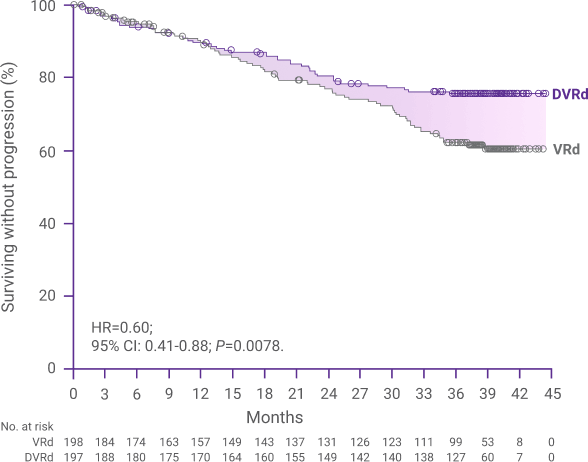
More patients achieved sustained MRD negativity and significantly reduced the risk of disease progression or death with DARZALEX FASPRO® + VRd vs VRd alone4

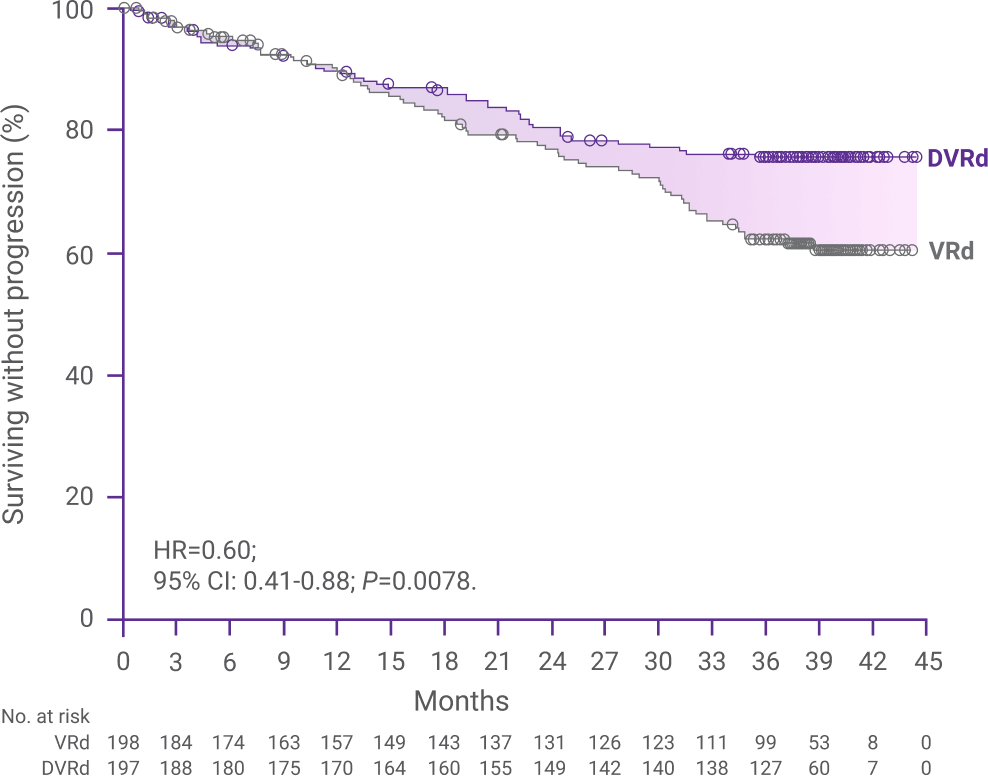
Progression-free survival

The median PFS has not been reached in either arm4

Progression-free survival (PFS) over 45 months, graphProgression-free survival (PFS) over 45 months, graph

40%reduction in the risk

for disease progression or death with DARZALEX FASPRO® + VRd vs VRd alone (HR=0.60; 95% CI: 0.41-0.88; P=0.0078)

Sustained MRD negativity*

42.6%

of patients achieved a sustained MRD negativity (10-5, ≥12 months) rate with DVRd vs 25.3% with VRd alone (P=0.0003)4

CI=confidence interval; DVRd=DARZALEX FASPRO® (D) + bortezomib (V) + lenalidomide (R) + dexamethasone (d); HR=hazard ratio; MRD=minimal residual disease; PFS=progression-free survival; VRd=bortezomib (V) + lenalidomide (R) + dexamethasone (d).

*Sustained MRD negativity is defined as confirmed MRD negative status at 2 examinations at least 1 year apart without MRD positive status in between.4

Final Analysis (59 Months)

For transplant-ineligible patients with newly diagnosed multiple myeloma

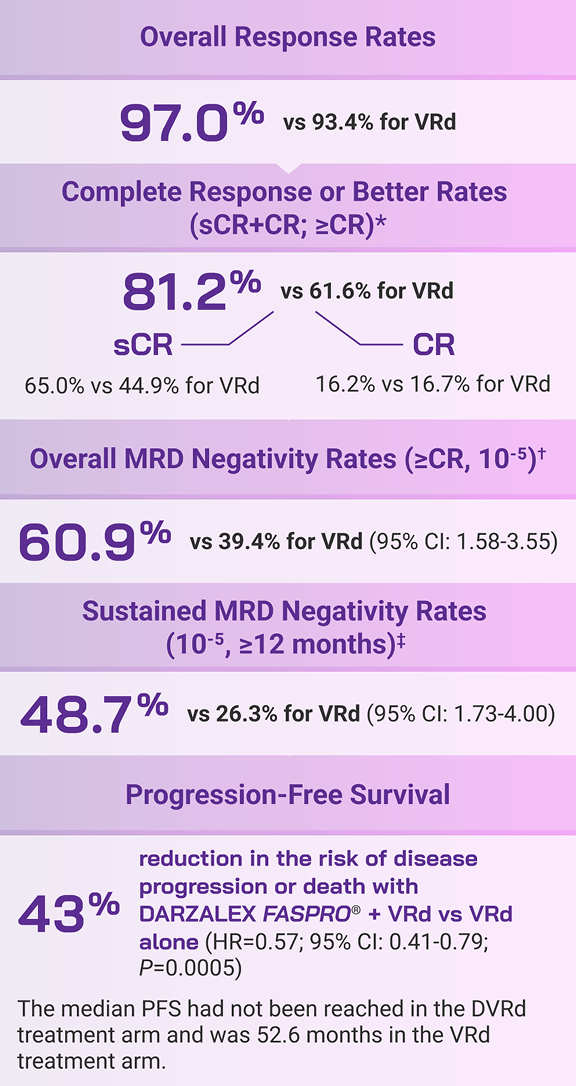
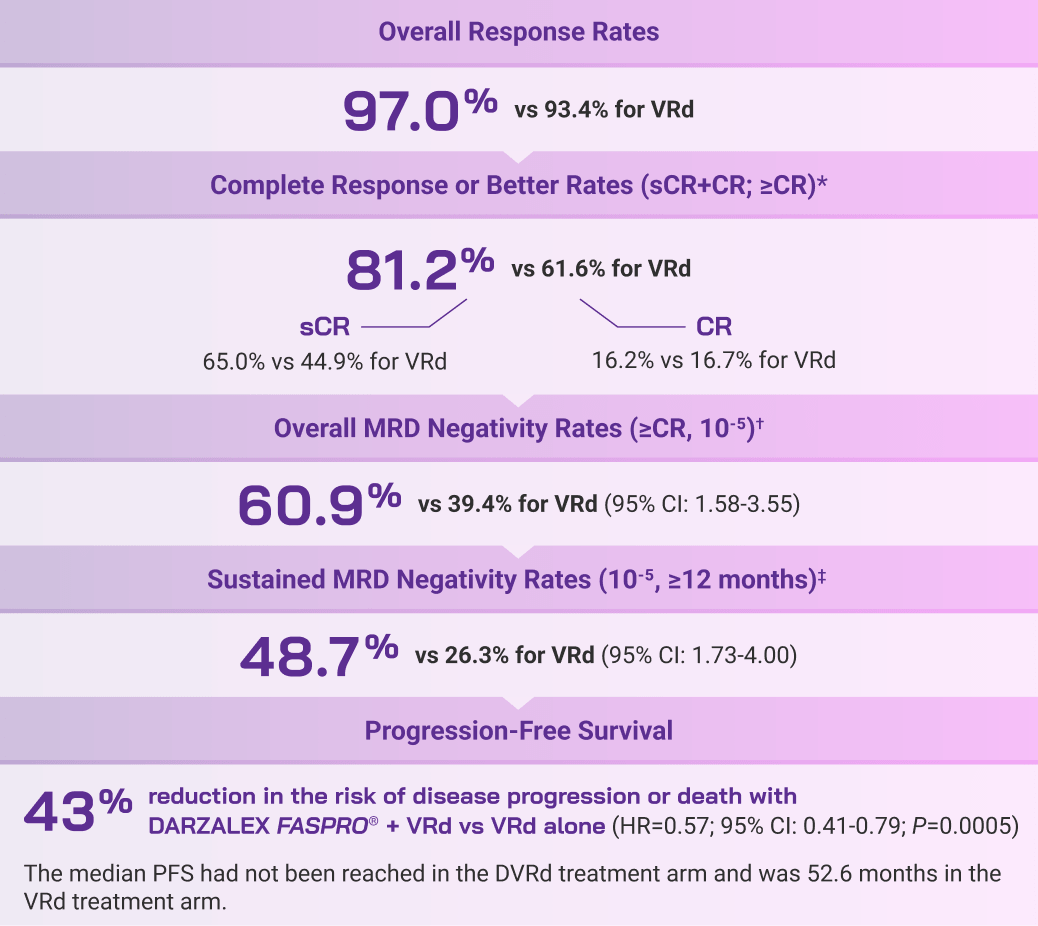
Deep & durable

DARZALEX FASPRO® + VRd continued to deliver improved clinical outcomes after 59 months4,5

Clinical outcomes after 59 months, graphicClinical outcomes after 59 months, graphic

CI=confidence interval; CR=complete response; DVRd=DARZALEX FASPRO® (D) + bortezomib (V) + lenalidomide (R) + dexamethasone (d); HR=hazard ratio; MRD=minimal residual disease; PFS=progression-free survival; sCR=stringent complete response; VRd=bortezomib (V) + lenalidomide (R) + dexamethasone (d).

*Stringent complete response (sCR) is CR plus a normal free light chain ratio and the absence of clonal plasma cells in bone marrow as assessed by immunohistochemistry or immunofluorescence.6

The overall MRD negativity rate was defined as the proportion of patients who achieved complete response or better and MRD negativity (at or below a sensitivity threshold of 10-5) after randomization but prior to disease progression, subsequent antimyeloma therapy, or both.5

Sustained MRD negativity is defined as confirmed MRD-negative status at 2 examinations at least 1 year apart without MRD-positive status in between.4

References:

  1. Munshi NC, Avet-Loiseau H, Anderson KC, et al. A large meta-analysis establishes the role of MRD negativity in long-term survival outcomes in patients with multiple myeloma. Blood Adv. 2020;4(23):5988-5999.
  2. Shi Q, Paiva B, Pederson LD, et al. Minimal residual disease–based end point for accelerated assessment of clinical trials in multiple myeloma: a pooled analysis of individual patient data from multiple randomized trials. J Clin Oncol. 2025;43(11):1289-1301. Published online February 12, 2025. doi:10.1200/JCO-24-02020
  3. Data on file. RF-462016. Janssen Biotech, Inc.
  4. DARZALEX FASPRO® [Prescribing Information]. Horsham, PA: Janssen Biotech, Inc.
  5. Usmani SZ, Facon T, Hungria V, et al. Daratumumab plus bortezomib, lenalidomide and dexamethasone for transplant-ineligible or transplant-deferred newly diagnosed multiple myeloma: the randomized phase 3 CEPHEUS trial. Nat Med. 2025;31(4):1195-1202.
  6. Facon T, Kumar S, Plesner T, et al; the MAIA Trial Investigators. Daratumumab plus lenalidomide and dexamethasone for untreated myeloma. N Engl J Med. 2019;380(22):2104-2115.